

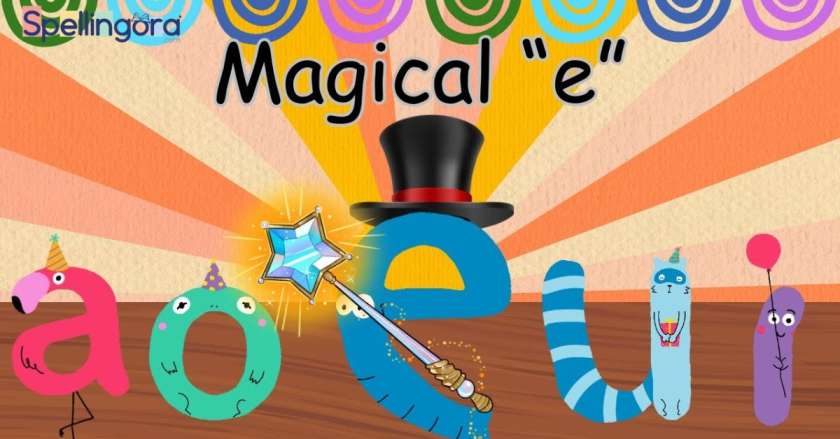
Magic E is a simple spelling rule that helps explain why some vowels make their long sounds. When a silent e appears at the end of a word, it often changes the vowel before it from a short sound to a long sound. For example, cap becomes cape, and kit becomes kite. Learning this pattern makes reading and spelling many common words easier.
How the rule works
The Magic E rule is easy to understand once you see the pattern. When a word ends with a silent e, the vowel before it usually says its long sound. The final e is not pronounced, but it changes the way the vowel is pronounced.
For example, cap has a short a sound, while cape has a long a sound. In the same way, kit becomes kite, changing the short i sound to the long i sound.
This pattern also works with other vowels. Words such as hop and hope, cub and cube, and pet and Pete show how adding a silent e can change the vowel sound.
Remember that the final e is called silent because we do not hear it when we say the word. Its job is to help the vowel say its name, making it a useful spelling pattern for reading and writing.
You can also read: How To Spell Restaurant or Restuarant? Which Spelling is Correct?
Examples that follow the rule
Here are some common examples of Magic E words. Notice how adding a silent e changes the short vowel sound into a long vowel sound.
- cap → cape
- tap → tape
- mad → made
- kit → kite
- rid → ride
- pin → pine
- hop → hope
- rob → robe
- not → note
- cub → cube
- tub → tube
- cut → cute
Magic E word list
A Magic E word list helps learners see how a silent e can change the vowel sound in a word. By comparing short-vowel words like cap, kit, and hop with long-vowel words like cape, kite, and hope, students can quickly recognize the pattern and improve their reading and spelling skills.
Magic E Word List

Magic E words show how a silent e at the end of a word can change a short vowel sound into a long vowel sound. The pairs below make this spelling pattern easy to recognize and practice.
Short Vowel (No Magic E)
- cap
- cod
- cub
- cut
- hat
- hid
- hop
- hug
- kit
- mat
- not
- pin
Long Vowel (Magic E Added)
- cape
- code
- cube
- cute
- hate
- hide
- hope
- huge
- kite
- mate
- note
- pine
The exceptions (rule breakers)
Spelling rules are useful guides, but they do not always work perfectly. Some common words end in a silent e while keeping a short vowel sound. These exceptions are best learned individually so they are easy to recognize and spell correctly.
have
The a remains short even though the word follows the vowel-consonant-e pattern.
give
The i has a short sound instead of the expected long i sound.
live
As a verb, live has a short i sound. The pronunciation can change when the word is used as an adjective.
love
The o has a short u sound, while the final e remains silent.
come
The vowel has a short u sound rather than the long sound expected from Magic E.
some
Like come, this word has a short u sound despite ending in silent e.
done
The o is pronounced with a short u sound, making it another common exception.
one
This word is pronounced like wun, so the o does not follow the usual Magic E pattern.
none
The vowel sound is similar to one, with a short u sound instead of a long o sound.
gone
The o has a short sound, even though the word ends with a silent e.
Common mistakes to avoid
Learning Magic E can be easier when you know which mistakes to watch for. Students often pronounce the final e, add an unnecessary e, or assume that every word ending in e follows the long-vowel rule.
Pronouncing the Silent E
Remember that the final e is usually not spoken. In cake, kite, and home, the e is silent while it changes the vowel sound.
Applying the Rule to Every Word
Not every word ending in e follows the Magic E pattern. Words such as have, give, and come are exceptions and need to be memorized.
Adding E Where It Does Not Belong
Do not add a silent e simply because you want a long vowel sound. Check the correct spelling before changing a word.
Forgetting the Vowel Change
The main purpose of Magic E is to change the vowel sound. Compare tap with tape or rid with ride to notice the difference.
Mixing Up Similar Words
Some Magic E pairs can sound very different in meaning. Practice reading and spelling both forms so you can recognize words such as hop and hope correctly.
FAQs
What is Magic E?
Magic E is a spelling pattern where a silent e at the end of a word often makes the vowel before it long.
Why is the E called silent?
The final e is usually not pronounced, but it can change the sound of the vowel earlier in the word.
What is an example of Magic E?
Cap becomes cape, and the short a changes to a long a sound.
Do all words ending in E follow the rule?
No. Words such as have, give, come, and some are common exceptions.
How can I practice Magic E words?
Practice short and long vowel pairs, read the words aloud, and write each pair several times to recognize the pattern.

Jack is an English language writer and grammar enthusiast with a passion for making learning simple and practical. He creates clear, easy-to-understand content on grammar, spelling, vocabulary, punctuation, and writing skills, helping readers improve their English with confidence.