

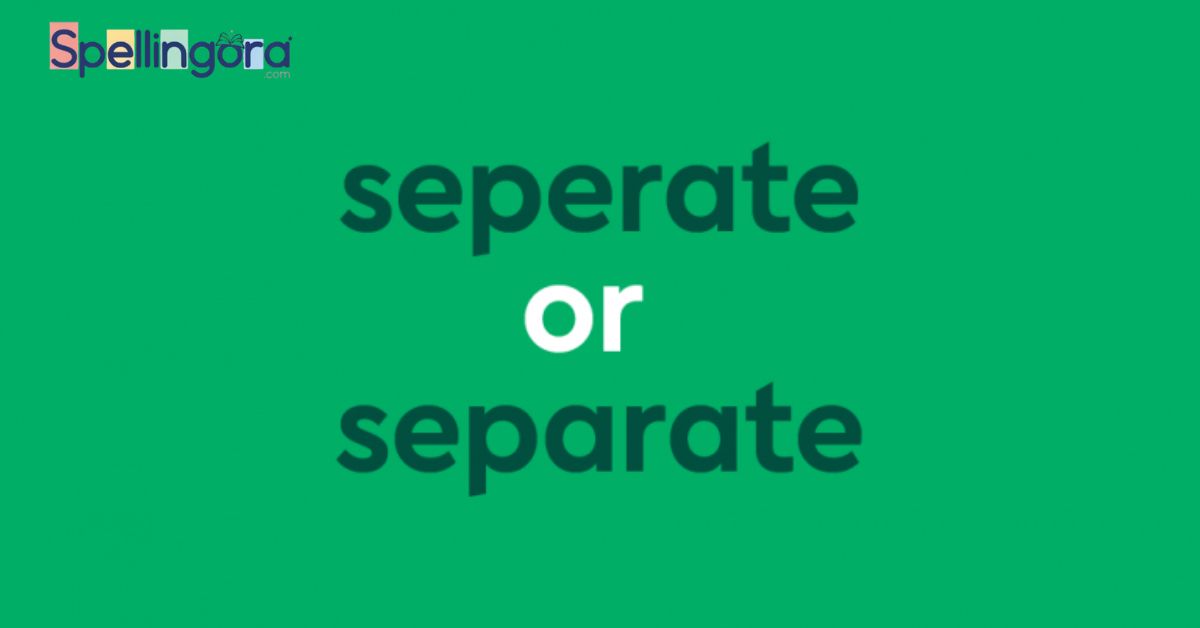
Learning how to spell separate correctly can be tricky because it contains a repeated e sound and is often confused with words like “seperate.” In this guide, you’ll learn the correct spelling, an easy memory trick, and simple examples to help you remember separate with confidence.
You’re Not Alone
Spelling separate correctly can be difficult because the word is often pronounced differently from how it looks. Many learners accidentally write “seperate” instead of the correct form “separate.” This small difference can make the word easy to misspell.
The good news is that this is a very common mistake, and learning the correct letter pattern makes it much easier to remember. Once you recognize that separate has “par” in the middle, you can avoid the common “seperate” spelling and write it confidently.
You can also read: How to Spell Cemetery
Why This Mistake Happens
The spelling of separate is often confusing because the word does not sound exactly the way it is written. When people say it quickly, the middle vowel sound can be unclear, making it easy to choose “e” instead of “a.”
Another reason this mistake happens is that seperate looks natural to many English learners. Since several common words use “e” in similar positions, people may spell separate based on how they hear it rather than its correct letter pattern.
The correct spelling is separate, with an “a” in the middle: s-e-p-a-r-a-t-e. Remembering this pattern can help you avoid the common misspelling “seperate” in your writing.
Word Origin
The word separate comes from the Latin word separare, meaning “to divide” or “to set apart.” It entered English through Old French and has been used for centuries to describe things that are divided, kept apart, or not joined together.
Its origin can also help you remember the spelling. Think of separate as something being set apart, and remember the “par” in the middle: s-e-p-a-r-a-t-e.
The Spelling Trick
A simple trick to remember separate is to focus on the word “par” in the middle. Think of it as sep + ar + ate. The correct spelling is s-e-p-a-r-a-t-e, not “seperate.”
You can also remember the phrase “There is a rat in separate.” The letters “a-r-a” in separate can help you recall the correct vowel pattern. Whenever you are unsure, break the word into parts: sep-ar-ate.
Alternative Mnemonics
Another easy way to remember separate is to think, “A rat is in separate.” The letters A-R-A appear in the middle of the word, helping you avoid the common “seperate” mistake.
You can also break the word into smaller parts: SEP + AR + ATE. Saying and writing these parts separately can make the correct spelling easier to remember and use confidently.
Examples in Context
Seeing separate in sentences can make its spelling easier to remember. These examples show how the word is commonly used:
- Please keep the two documents separate.
- We decided to sit at separate tables.
- The teacher gave us separate assignments.
- The rooms are separate from each other.
- Make sure to pack the clothes in separate bags.
Common Mistakes to Avoid
The most common mistake is spelling separate as “seperate.” Remember that the correct spelling contains “a” in the middle and ends with “-ate.” Always write it as s-e-p-a-r-a-t-e to avoid this error.
When spelling separate, people often make mistakes by replacing the “a” with an “e”. Watch out for these common errors:
- Seperate → incorrect; the middle vowel should be a.
- Seperete → incorrect; the correct ending is -ate.
- Seperat → incorrect; do not forget the final e.
- Separite → incorrect; use -ate, not -ite.
The correct spelling is separate: s-e-p-a-r-a-t-e.
FAQs
How do you spell separate?
The correct spelling is separate.
Is it separate or seperate?
Separate is correct; seperate is incorrect.
What is the meaning of separate?
Separate means to keep things apart or divide them.
What is an easy trick to spell separate?
Remember “A rat is in separate” to recall the a-r-a pattern.
How do you use separate in a sentence?
Example: Please keep these files separate.

Jack is an English language writer and grammar enthusiast with a passion for making learning simple and practical. He creates clear, easy-to-understand content on grammar, spelling, vocabulary, punctuation, and writing skills, helping readers improve their English with confidence.