

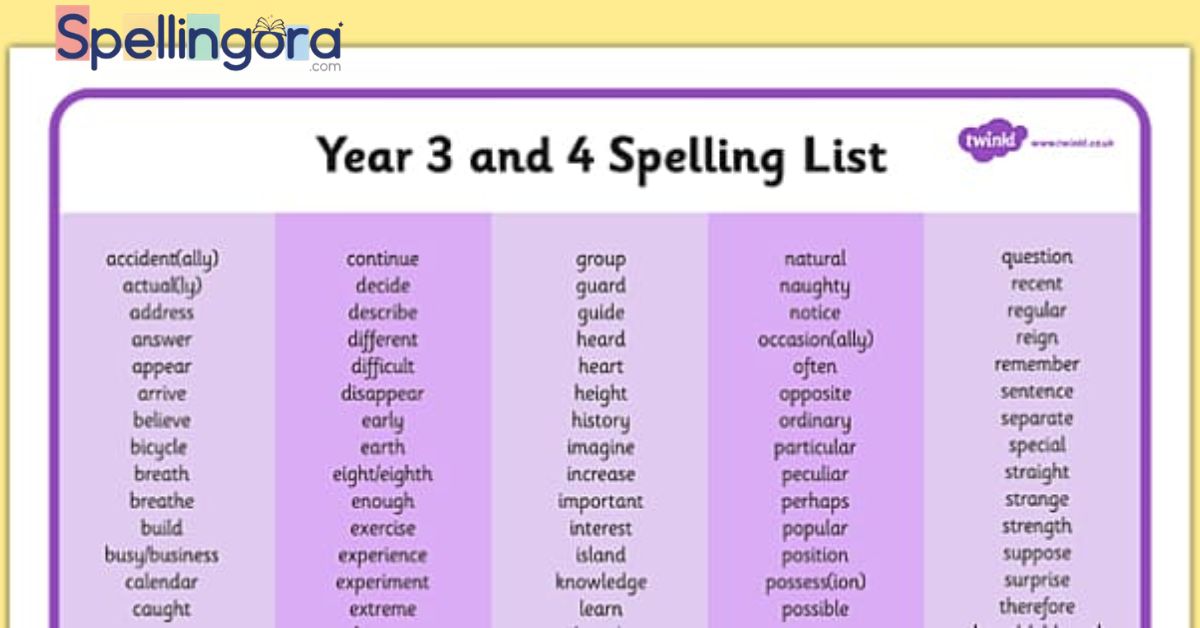
Building strong spelling skills in Year 3 helps children become more confident readers and writers. This Australian Year 3 spelling words list includes common, useful, and age-appropriate words that support classroom learning, vocabulary development, and everyday writing. Regular practice can help students recognise spelling patterns, remember tricky words, and use new vocabulary with confidence.
Year 3 spelling word list
A Year 3 spelling word list helps children strengthen their spelling, reading, and writing skills through regular practice. It includes common words, tricky spellings, useful vocabulary, and words that introduce important spelling patterns. Practising these words regularly can improve confidence, accuracy, and overall language skills at school and at home.
You can also read: How to Spell Maintenance
Australian Year 3 Spelling Words
Australian Year 3 spelling words help children build confidence in reading and writing by practising common words, spelling patterns, and useful vocabulary suited to their age and classroom level.
Vowel teams and variant patterns
- head
- bread
- breath
- weather
- steady
- moon
- boots
- smooth
- proof
- choose
- town
- brown
- crown
- frown
- drown
- thought
- bought
- brought
- caught
- taught
- laugh
Silent letters (kn-, wr-, -mb)
- knee
- knife
- knock
- knot
- know
- knockout
- write
- wrong
- wrist
- wrap
- wreck
- wrote
- climb
- lamb
- thumb
- comb
- crumb
- numb
- limb
- dumb
Prefixes and derivational suffixes
- unhappy
- unfair
- unhelpful
- rewrite
- replay
- retell
- dislike
- disagree
- discover
- careful
- helpful
- hopeful
- kindness
- happiness
- darkness
- quickly
- slowly
- teacher
- runner
- colourful
Homophones (Year 3)
- there
- their
- they’re
- where
- wear
- were
- here
- hear
- to
- too
- two
- right
- write
- new
- knew
- one
- won
- see
- sea
- be
Latin suffix -tion
- action
- station
- nation
- motion
- section
- direction
- collection
- education
- information
- attention
- invention
- celebration
- population
- protection
- instruction
- description
- conversation
- operation
- solution
- competition
How to practise with this list
Start with one group
Begin with a small group of spelling words rather than trying to learn too many at once. Focus on the spelling pattern, read each word aloud, and practise writing them several times.
Hear, then spell
Say each word clearly and listen carefully to its sounds before writing it. Breaking the word into smaller sounds or syllables can make tricky spellings easier to remember.
Revisit tricky words
Keep practising words that are difficult to spell and review them regularly. Writing each tricky word in a sentence can help you remember both its spelling and meaning.
FAQs
What are Australian Year 3 spelling words?
They are age appropriate words that help Year 3 students improve spelling, reading, and writing skills.
How can Year 3 students practise spelling?
Students can read words aloud, write them repeatedly, use them in sentences, and practise a few words each day.
Why are homophones included in Year 3 spelling?
Homophones help children understand words that sound alike but have different meanings and spellings.
How can children remember tricky spellings?
Regular revision, sounding out words, and using difficult words in sentences can make them easier to remember.
How many spelling words should children practise at once?
Starting with a small group of words can make practice more manageable and help children learn each spelling correctly.

Jack is an English language writer and grammar enthusiast with a passion for making learning simple and practical. He creates clear, easy-to-understand content on grammar, spelling, vocabulary, punctuation, and writing skills, helping readers improve their English with confidence.